The problem with gamification in banking isn't the game. It's what the game rewards.
New research confirms that game mechanics can change financial behaviour. But getting customers to do more isn't the same as helping them do better.
A banking app that gets opened more often is not necessarily a better banking app. A banking app that helps customers become financially stronger is.
That distinction matters because banks have spent years investing in digital engagement, measuring success through logins, transactions, time spent and product uptake. These are useful commercial measures. But they tell us surprisingly little about whether customers are actually getting better at managing their money.
Gamification has the same problem. Points, badges, streaks and rewards can encourage people to do more of almost anything. The question is whether the behaviour being encouraged is good for them.
Two recent publications bring this into focus: a systematic review of gamification in finance1 and an updated analysis of gamified financial apps by Yu-kai Chou, creator of the Octalysis framework.2
Both point toward a conclusion that has shaped Moroku's development of Odyssey:
Engagement is a measure of attention. Financial progress is a measure of value.
The best financial experiences should deliver both.
Gamification works. But what is it working towards?
A 2026 systematic review attributed to Rizwan, Malik and Hussain examines 43 studies published between 2014 and 2024, exploring how game mechanics influence financial behaviour.
The findings reported in the review are encouraging. Gamification can increase engagement, improve financial literacy and influence saving, spending and investing behaviours.
But the review also identifies the other side of the equation: fatigue, manipulation, excessive trading and reduced sensitivity to financial risk.
This is the uncomfortable truth about gamification. It can be effective at changing behaviour without necessarily improving outcomes.
Reward a customer for logging into an app and they may log in more often. Reward transaction frequency and they may transact more. Reward trading activity and they may trade more frequently than is good for them.
The mechanics are doing their job. The problem is what they've been asked to achieve.
For banks, the question is no longer simply whether gamification increases engagement.
It is whether the behaviours being encouraged leave customers financially stronger.
Money is already the reward
Yu-kai Chou makes an interesting observation in his updated analysis of gamified finance apps.
Finance is unusually difficult to gamify because money already carries its own incentives. Adding points to financial activity can become little more than adding another layer of rewards to something that already has a measurable value.
The more interesting opportunity is to make financial progress visible.
Consider someone trying to build an emergency savings buffer.
A conventional rewards programme might award 50 points for making a deposit. The customer sees their points balance increase, but what does that tell them about their financial position?
Very little.
Now imagine that same deposit moves their emergency buffer from covering 17 days of expenses to 21 days.
The customer hasn't just earned something. They've achieved something.
They can see what their money is doing for them.
Chou highlights examples such as YNAB's Age of Money and Fortune City's visual representation of financial activity. These experiences make otherwise abstract financial behaviour tangible.
The principle is simple:
Don't just reward the transaction. Show the customer what the transaction changed.
That is a much more powerful foundation for lasting financial habits.
From engagement to financial fitness
This is the problem we built Moroku Odyssey to address.
Banks already have enormous amounts of information about their customers' financial lives. They know when money arrives, where it goes, how regularly customers save, how they manage debt and how their financial position changes over time.
Yet most digital banking experiences do little more than report this information back.
Balances. Transactions. Categories. Statements. Alerts.
Useful, certainly. But largely descriptive.
Odyssey is designed to turn that information into something more useful: an understanding of where a customer is financially, what they could improve and how to help them make progress.
It uses transaction-derived behavioural measures to build a picture of financial fitness and translate that picture into personalised journeys, missions, challenges and rewards.
The objective isn't to get customers playing a banking game.
It is to help them develop better money habits, with the motivational techniques of games making that progress easier to understand and sustain.
Not all motivation is created equal
Chou's Octalysis framework distinguishes between two broad families of motivation.
White Hat motivation draws on accomplishment, meaning, creativity and a sense of control. It encourages people because progress feels worthwhile.
Black Hat motivation draws on scarcity, unpredictability and fear of loss. It can create urgency, but may also produce anxiety and fatigue.
| White Hat | Black Hat | |
|---|---|---|
| Draws on | Accomplishment, meaning, creativity, control | Scarcity, unpredictability, fear of loss |
| How it feels | Progress feels worthwhile | Urgent, sometimes anxious |
| Banking example | A savings challenge that builds confidence | A trading prompt about missing the next opportunity |
| Risk | Can lose urgency if used alone | Fatigue, churn and conduct concerns if overused |
Both can influence behaviour. But finance is an environment where the consequences of getting the balance wrong can be serious.
A savings challenge that helps someone build confidence is fundamentally different from a trading experience that creates anxiety about missing the next opportunity.
The Robinhood regulatory case in Massachusetts illustrated how engagement mechanics can become a conduct concern when applied to financial decisions.3
For banks, this means gamification cannot be treated simply as a marketing or interface feature.
It needs to be designed around customer outcomes, with appropriate controls over what behaviour is encouraged and why.
The question isn't whether a mechanic makes someone act. It's whether that action is in their interests.
Four tests for better financial engagement
The research suggests four useful questions that banks should ask before introducing game mechanics into a financial experience.
Does it make progress visible?
A customer should understand how an action improves their financial position.
A deposit might extend their emergency buffer. A regular repayment might demonstrate improved debt management. A savings habit might move them toward a meaningful goal.
Progress needs to mean something beyond accumulating points.
Is it personal?
Two customers with the same account balance may have very different financial circumstances, motivations and needs.
One may need to build financial resilience. Another may need to manage debt. A third may be ready to develop an investment habit.
Giving everyone the same challenge or streak ignores those differences.
Does it reward better behaviour rather than more activity?
An engagement programme should distinguish between actions that create value and actions that merely generate activity.
More logins are not necessarily better banking. More transactions are not necessarily better financial management.
The most meaningful measures are changes in the customer's financial behaviour and position.
Can the bank explain and govern it?
Financial institutions need to understand why a customer receives a particular recommendation, challenge or reward.
They need to control which behaviours are encouraged, monitor outcomes and prevent incentives from producing unintended consequences.
An engagement engine that cannot be explained or governed is a liability, not an advantage.
How Odyssey puts those principles to work
Odyssey is built around four corresponding capabilities.
Financial progress customers can see
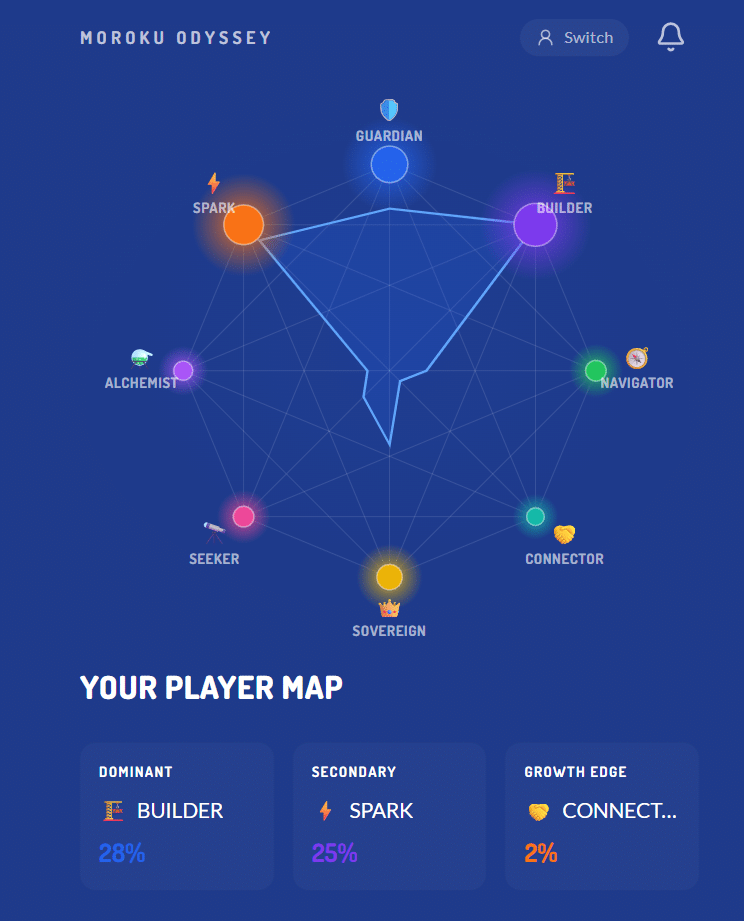
Odyssey uses transaction-derived measures of financial fitness to place customers on a Player Map, with levels, leagues, missions and challenges that reflect their behaviour.
Rather than accumulating points disconnected from their financial lives, customers can see where they are, how they are progressing and what they could do next.
The journey is designed around progress over time, not simply activity within an app.
Personalisation based on financial behaviour
Odyssey uses a model of eight financial archetypes to interpret patterns in how customers manage money.
These archetypes provide a framework for understanding differences in financial behaviour and tailoring the experiences offered to customers.
Instead of requiring everyone to complete the same journey, Odyssey is designed to adapt missions and challenges to the customer's circumstances and opportunities for improvement.
The aim is to make financial coaching relevant to the individual rather than treating the entire customer base as one audience.
Missions tied to real outcomes
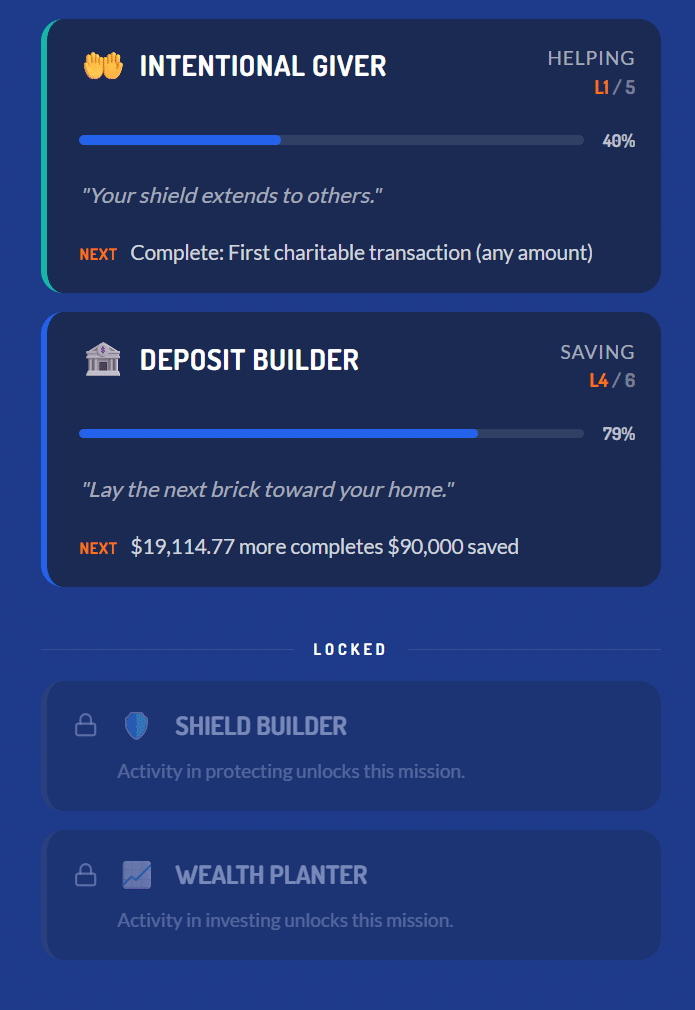
Odyssey missions such as Deposit Builder, Income Builder and Intentional Giver are connected to measurable financial behaviours.
Customers progress by developing habits, reaching thresholds and demonstrating changes in how they manage money.
A savings mission, for example, can reward consistency rather than the number of times someone opens an app.
As customers progress, relevant banking tools such as savings goals, pots, round-ups and automated transfers can be introduced at the point they become useful.
The game mechanics support the financial journey rather than becoming the destination.

AI that banks can govern
Personalisation introduces another responsibility: ensuring that AI-driven coaching remains understandable and controlled.
Odyssey is designed to work with structured behavioural measures, defined rules and constrained AI outputs.
Its Bring Your Own Model approach allows institutions to choose and govern the AI model used for supported coaching functions, with behavioural scores rather than raw transaction records passed across that model boundary.
The intention is to combine personalisation with the control and auditability that regulated financial institutions require.
Better for customers. Better for banks.
There is a commercial argument here as well as a customer one.
Banks benefit when customers are engaged, but engagement is more valuable when it reflects a strengthening financial relationship.
A customer who builds a reliable savings habit may develop a deeper deposit relationship.
A customer who better understands borrowing and repayment may become a more confident, sustainable borrower.
A customer who can see progress toward a financial goal has a meaningful reason to return to their bank.
These are not automatic outcomes, and they need to be measured. But they represent a more valuable ambition than increasing app sessions for their own sake.
The opportunity for banks is to connect customer wellbeing with commercial performance, rather than treating them as competing objectives.
Banking that coaches, rather than simply counts
Banks have spent the past decade making banking digital.
The next opportunity is to make it genuinely useful in helping customers improve their financial lives.
That requires more than dashboards, spending categories or rewards programmes. It requires an understanding of behaviour, a way to identify useful next steps and a system that helps customers act on them.
Gamification has an important role to play, but only when the game is designed around the right outcomes.
The ambition is not to turn banking into a game.
It is to use what we know about human motivation to help people build better money habits.
That is what Odyssey was built to do.
See what your bank could do with the data it already has
See how Moroku Odyssey turns banking transactions into personalised financial missions, visible progress and coaching experiences.
Book an Odyssey demonstration Explore OdysseyReferences
- Rizwan, Malik and Hussain (2026), Gamification in finance: A systematic review and research agenda, Journal of Behavioral and Experimental Finance, 50, 101180. doi.org/10.1016/j.jbef.2026.101180
- Yu-kai Chou (2026), Top 10 Gamified Finance Apps, updated October 2026. yukaichou.com
- Massachusetts Securities Division, Robinhood Financial enforcement proceedings and January 2024 settlement. sec.state.ma.us