Money Is Not Easy to Use
Why the next generation of banks will be built as games.
Ease of Use Has Run Out of Road
For thirty years, the organising principle of digital design has been ease of use. Reduce the steps. Remove the friction. Make the thing effortless. It has been a spectacularly successful idea, and in most industries it still is. If the job is to hail a car, book a room, or order dinner, effortlessness is the whole product.
Banking adopted that principle wholesale, and executed it. Onboarding went from weeks to minutes. Payments went from branches to thumbprints. Balances went from statements to glances. It worked.
And it produced two problems that the industry is only now confronting honestly.
Problem One: Every Bank Now Looks the Same
We said this would happen, and it has. When every institution optimises the same journeys against the same best practice, using the same handful of core vendors, the same card rails, the same payment schemes, and increasingly the same design language, convergence is not a risk; it is the arithmetic.
Open a dozen banking apps side by side. Balance at the top. Cards in a carousel. Transactions in a list, with a search icon. Pay, transfer, more. A spend-by-category donut chart that nobody has ever acted on. The colours differ. Nothing else does.
Ease of use is now table stakes. It is the cost of being allowed to compete, not a way of winning. A capability every competitor has and every customer expects is, by definition, not a differentiator. Which leaves the industry with an uncomfortable question: if the interface is the same everywhere, what exactly is the reason to choose you, or to stay?
Problem Two: Money Is Not Easy to Use
This is the deeper one, and it is the one the industry keeps designing around rather than at.
You can make an interface easy. You cannot make money easy. Money is genuinely hard. It requires deferring gratification against an uncertain future, holding several time horizons in mind at once, resisting powerfully engineered temptation, understanding compounding and risk, and doing all of this continuously, under stress, usually without ever having been taught.
No amount of interface polish touches any of that. A frictionless app makes it easier to spend; it doesn't make it easier to save. It makes it easier to borrow, but not easier to pay back. It makes it easier to check a balance you are powerless to change. Ease of use, applied to a hard domain, optimises the wrong thing: it makes the transaction effortless while leaving the competence untouched.
The evidence is everywhere. Financial literacy has not moved. Household buffers remain thin. People with excellent banking apps still cannot answer whether they are doing well. The apps are easy. The customers are not getting better.
Strong Customers, Strong Banks
The banks that compete and thrive in the next decade will be the ones whose customers compete and thrive.
This is not a corporate-responsibility statement. It is a commercial one. A customer who gets financially stronger holds more products, holds them longer, defaults less, saves more, borrows better, and tells other people. Customer financial progress and bank commercial performance are the same curve measured from two ends. Every institution says this. Almost none of them have an engine that actually does it, because doing it requires a design architecture that the industry has never adopted.
That architecture already exists. It is just not in banking.
Why Game
Here is the claim, stated plainly: game is the only design architecture humanity has that reliably makes people better at hard things.
Think about what it takes to become good at soccer, tennis, chess, backgammon, or a language. All of them are hard. All of them require sustained effort against delayed reward. And in every case the thing that carries people through is the same set of structures:
- A league that tells you who you are playing with, and against; a context where your effort is meaningful and comparable.
- Levels that break an impossible goal into a ladder of achievable ones.
- Challenges that are concrete, measurable, and just beyond current ability.
- Feedback that is immediate, honest, and specific.
- Coaching that adapts to who you are, not just what you did.
- Mechanics such as scores, streaks, ranks, rivalry and celebration, that make the next repetition worth doing.
Nobody becomes good at tennis by being given a frictionless racquet. They become good by playing a structured game, repeatedly, with feedback, at a level that stretches them. Duolingo did not make languages easy; it made them playable, and in doing so it built the largest language-learning population in history.
To be clear, none of this is about play in the trivial sense. A game, properly built, is a machine for overcoming challenges and building skills. It is what Mihaly Csikszentmihalyi identified as flow: the state of complete absorption people enter when the challenge in front of them and the skill they bring to it rise together, each stretching the other. Too easy and they are bored; too hard and they are anxious; matched, and they grow. Nobody is entertained into competence. They are stretched into it.
This is why “gamification” as the industry practises it, a badge bolted onto a savings goal, fails and deserves to. Points and badges are the mechanics, and mechanics without morphology are decoration. The power is in the structure: leagues, missions, levels, challenges. The mechanics make that structure move.
Money is exactly the kind of hard, repeated, feedback-poor domain that game architecture was made for. That is why we built Odyssey.
The ArchitectureThe Odyssey Morphology
Odyssey encodes a complete morphology of play, researched from the game literature and tested inside real banking applications with real customers.
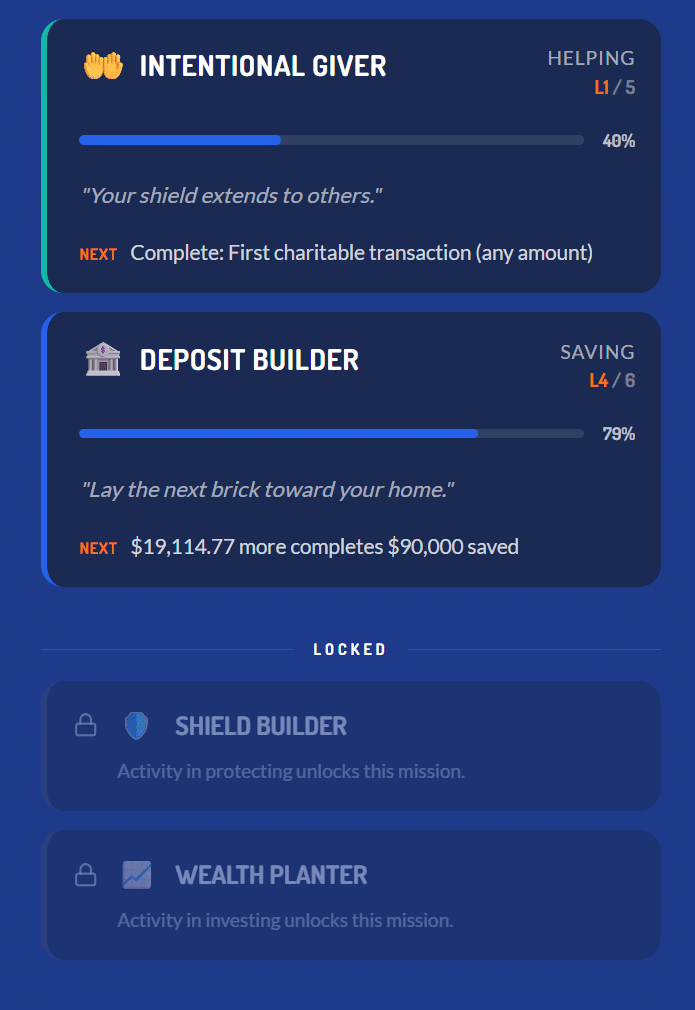
The high-order frame. Youth. Professional. SME. Retiree. A league sets the terms of the game: what a good outcome looks like, what a fair comparison is, what content and language make sense. A 22-year-old apprentice and a 58-year-old business owner are not playing the same game, and should never be scored on the same board.
Eight money systems: earning, spending, saving, borrowing, investing, protecting, retirement, helping. These are the domains of financial life. They are Moroku's pedagogy and they do not move; they are the map's coordinate system.
Every mission has a five-rung ladder: Aware → Active → Skilled → Fit → Master. Awareness precedes action; action precedes consistency; consistency precedes scale; scale precedes resilience. The ladder is what turns “get better with money” into a sequence a human being can actually walk.
The concrete, measurable undertaking inside a level: save $500 across 90 days; hold the grocery budget for a quarter; make three extra principal payments running. Challenges are where the bank expresses its own product reality and its own customer base, composed from a catalogue of measures the engine can genuinely observe in the transaction stream. If we cannot measure it, we do not promise it.
Points, badges, streaks, levels, leaderboards, competitions, tournaments, happy hours, content, celebration moments. This is the layer that supplies motivation, rhythm and delight; the reason to come back tomorrow. It sits on top of the morphology, never in place of it.
The Player Map: Where the Customer Is
Run that morphology across a customer base and you get a map. Eight missions, five levels, measured across time, space and momentum. Every customer occupies a position on it, a set of coordinates describing where they are on their journey with money, mission by mission.
This is not segmentation. Segmentation tells you what a customer has: age, income, product holdings. The Player Map tells you where they are: Skilled at spending, Aware at protecting, Active at saving, not yet investing. That is a fundamentally more useful thing to know, because it tells you what to do next.
The map has more than 1.4 billion possible player positions. That number is not an accident; it is roughly the number of unbanked adults on earth. It is the mission, expressed as a coordinate space.
The Archetypes: Who the Customer Is
Knowing where someone is on the map tells you what they need. It does not tell you how to reach them. Two customers at the identical coordinate will respond to completely different things: one wants a target and a scoreboard, the other wants reassurance and protection, a third wants to be shown the system and left alone to master it.
So the second half of the model asks a different question: who is this person, and how do they play?
The Moroku Player Map synthesises three independent research traditions, each answering a question the others do not:
- Jung / Pearson (Awakening the Heroes Within): who are they? Universal psychological archetypes describing fundamental human orientation.
- Bartle (Player Types): how do they play? Achievers, Explorers, Socialisers, Killers: how people respond to game mechanics, competition and challenge.
- Deborah Price (Money Magic): how do they relate to money? Money-specific psychological patterns observed in financial coaching practice.
The synthesis is the intellectual property. Without Jung/Pearson there is no identity. Without Bartle there is no engagement mechanic. Without Price it is a general personality instrument pointed at finance rather than a financial one.
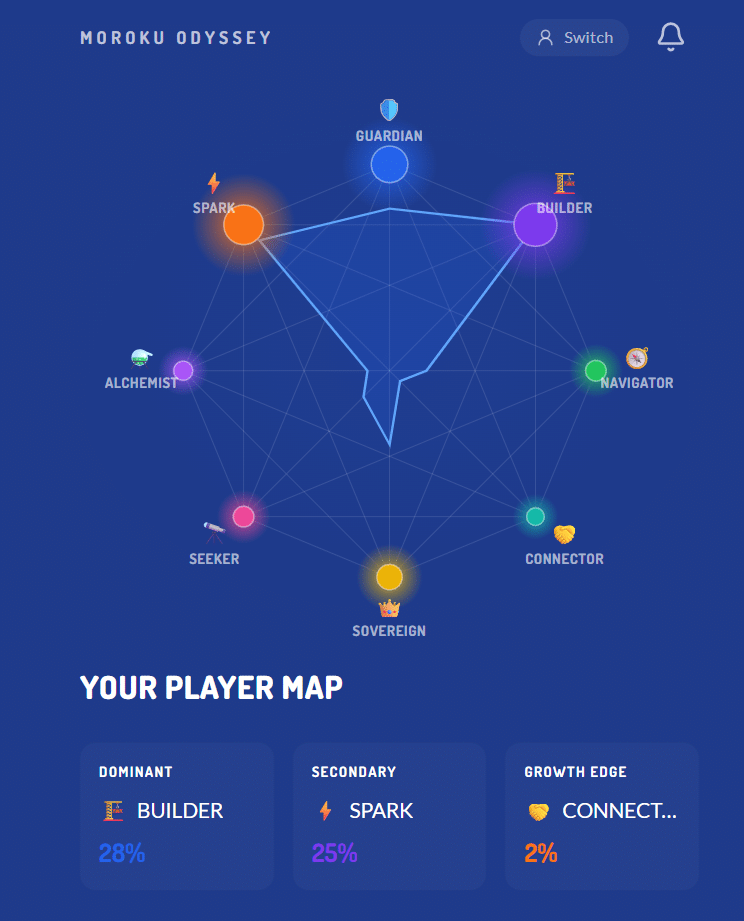
The result is eight financial archetypes:
Critically, nobody is a pure type. Every customer is expressed as a blend, a distribution across all eight that sums to one. Builder 42%, Sovereign 28%, Navigator 18%, the rest small. The dominant archetype drives mission design. The secondary shapes tone. The lowest is the growth edge. Two customers both labelled “Builder” with different second archetypes need materially different treatment, which is why the blend, not the label, is the insight.
How the Machine Works
The architecture is deliberately simple to connect to and deliberately deep behind the connection.
In
Transaction data from the core, extended by open banking data where it is available. That is the integration. No customer master file, no survey, no questionnaire. A player record is created the first time we see a transaction.
Infer
The stream is reduced to a set of normalised behavioural signals: savings regularity, spending variance, protection spend, gift and family ratio, emergency-fund behaviour, and so on. From those signals the engine infers both halves of the picture: the customer's position on the Player Map, and their archetype blend.
Act
Position plus archetype determines the next best move: which mission to surface, which challenge to set at what level, what tone to say it in, which content to serve, when to nudge and when to stay quiet.
Learn
What the customer does next is more signal. Engagement, completion, lapse, recovery; all of it feeds back. The map sharpens, the blend sharpens, the calibration sharpens.
Deterministic first, intelligent over time
This matters, because it is where most AI claims in this industry fall over. Odyssey starts with an explicit, inspectable affinity model: a research-grounded mapping from signals to archetypes that produces a defensible position from day one, without an AI call. Once a customer has accumulated enough evidence, large language model inference activates on top: it reasons across the full signal vector using the three-tradition vocabulary, and refines the blend. Every inference returns a confidence score and the specific signals it weighted most heavily, so every conclusion can be checked against the customer's actual history rather than taken on faith.
What the Bank Ends Up Owning
Moroku owns the framework: the morphology, the pedagogy, the archetype model, the measure catalogue. The bank instantiates it, and what the bank builds on top compounds and does not transfer to a competitor:
- The behavioural graph of its own customer base
- The signal anchors that prove what actually drives progress in its population
- The mission and challenge configurations tuned to its products and its market
- The engagement patterns that emerge from its own customers playing
Every day the engine runs, that asset gets deeper. That is a competitive position that cannot be bought off the shelf, because it is made of the bank's own customers' behaviour.
The TakeawayWhere This Leaves the Conversation
The industry has spent three decades making banking easy and has arrived at a place where every bank is easy and no customer is better off. The next differentiator is not a smoother journey. It is a stronger customer.
Send Us Your Transaction Stream.
We will show you your customers: where they are on the map, who they are as players, and what to do next for every one of them.
Moroku Pty Ltd · Sydney, Australia · moroku.com